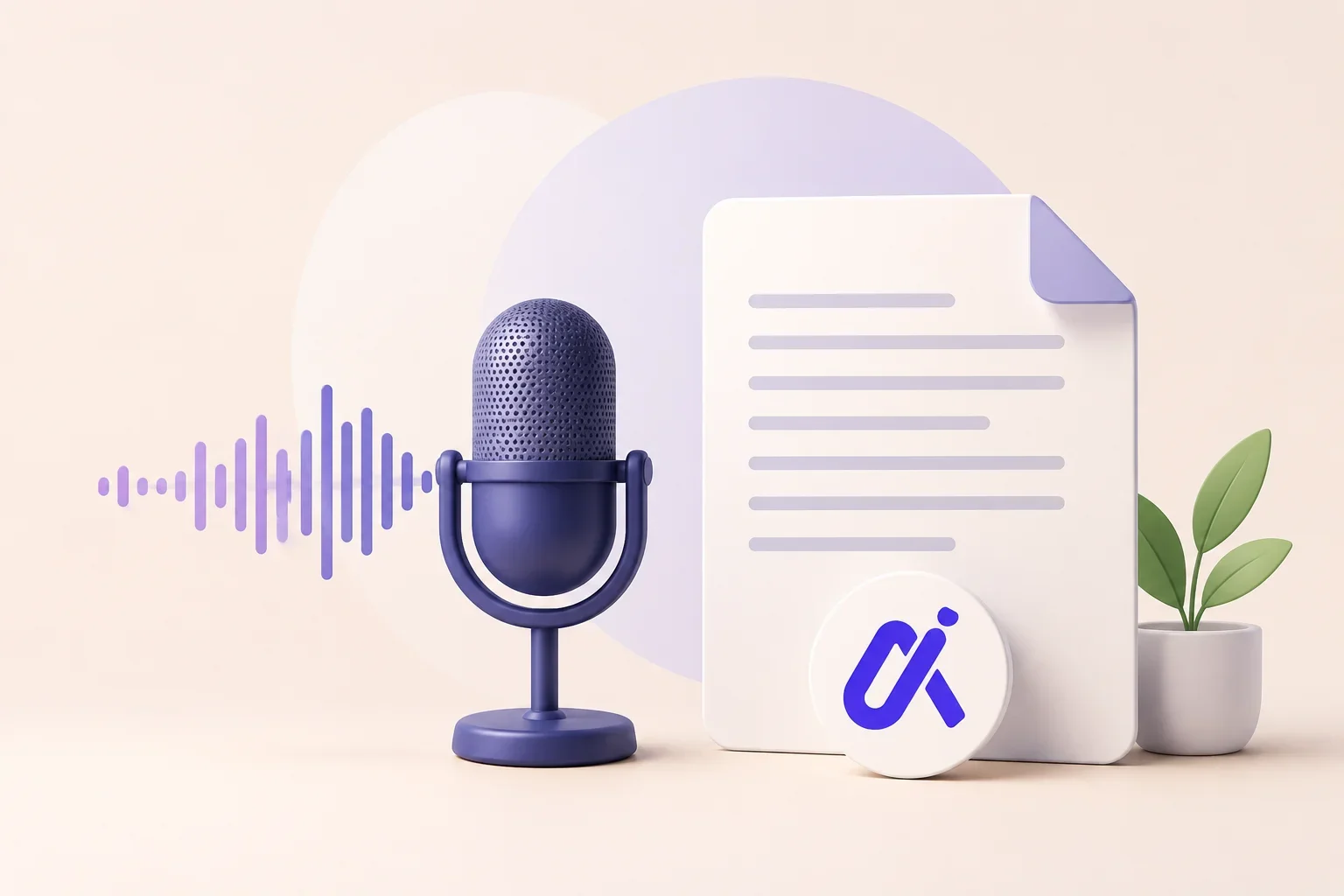
Audio files can be turned into text with AI transcription software, which breaks down spoken words, recognizes which words are punctuated, correctly determines the voice of a speaker, and generate a text transcript of the recording that can be modified. Such software can come in quite handy for creators, businesses, students, journalists, researchers, marketers and podcasters.
How Does AI Transcription Software Convert Audio to Text?
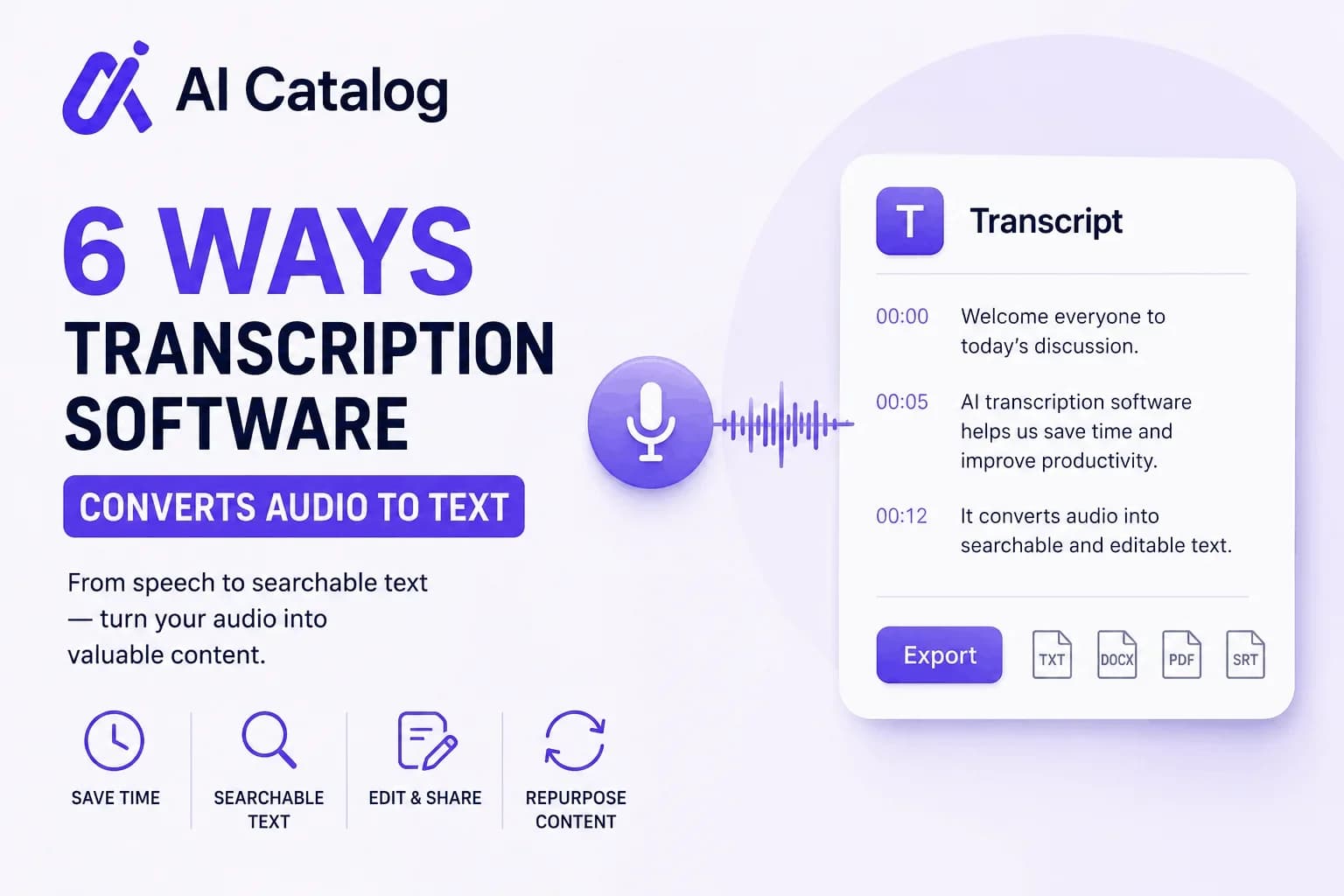
Conversion of audio recordings to text through AI transcription software occurs in six key steps.
1. Captures and Processes Audio
Transcription software works with audio files, video files, voice recordings, conferences, podcasts, interviews, and lectures. It captures the input signal and prepares speech for recognition.
The step of audio processing is done in order to prepare the input audio signal. The system recognizes different file formats and qualities depending on the platform used.
2. Uses AI Speech Recognition
The process of automatic speech recognition (ASR), also known as AI speech recognition, allows converting speech signals into texts. The system analyses words, phrases, pronunciation, pauses, and speech intonations.
Modern artificial intelligence for transcribing speech to text, AI-based audio transcription, and audio-to-text software recognize various accents, speech rates, and styles.
3. Separates Different Speakers
AI can make use of speaker diarization to differentiate between various speakers and number them as Speaker 1, Speaker 2, or Speaker 3.
This is beneficial in case of meetings, podcasts, interviews, conferences, discussions, or interviews done for research purposes. Thus, AI-based tools that are used for transcribing interviews can save one from the trouble of organizing manually.
4. Adds Punctuation and Formatting
Modern AI transcription tools for podcasts can generate commas, periods, question marks, paragraph breaks, and speaker breaks. Also, some advanced transcription systems can recognize topics, sections, headings, and main points.
5. Improves Accuracy With AI Context
Modern automatic transcription software use context to anticipate possible words and thus improve brand names recognition, jargon, technical terms, and commonly used phrases recognition.
Although many AI transcription systems offer the option to create a custom dictionary, accuracy can be affected by ambient noise, pronunciation problems, accents, overlapping speakers, and jargon.
6. Creates Searchable and Editable Transcripts
A generated transcript becomes editable, searchable, organized, sharable, storaged, and reusable. Some popular export formats are TXT, DOCX, PDF, and SRT files.
AI transcription software go beyond the simple speech-to-text solution. They generate Searchable Text.
What Are the Main Benefits of AI Transcription Software?
Save Time
Transcribing audio files manually involves constantly listening, pausing, going back, and typing. Typically, transcription using software tends to be faster.
Improve Content Accessibility
Text transcripts allow for better accessibility and convenience for those who prefer to read rather than listen.
Repurpose Existing Content
With one audio file, you will be able to produce:
Blog post content
Social media posts
Article content
Subtitles
Notes from a meeting
Newsletters
Description of videos
Content repurposing allows you to maximize your existing recordings.
Make Audio Content Searchable
Transcripts that are searchable enable you to find quotes, names, facts, and topics without having to listen to the whole audio file.
Who Can Benefit From Transcription Software?
Content Creators can utilize the application of speech-to-text programs to assist them in choosing podcast recordings, interviews, or video interviews into text.
AI transcription software allows journalists to quickly transcribe interviews and discover compelling quotes.
The students could use the AI transcription software to convert lectures into study materials.
For meetings, the AI transcription software is a useful resource for companies to use in order to make things easier for them and so they will be able to transcribe what was said during the meeting and use those meeting minutes and notes to create follow-up documents.
Researchers can use AI transcription tools to help transcribe qualitative data that can be conducted verbally. AI transcription services can support researchers in transcribing audio recordings for qualitative data.
Marketing-friendly written communications and articles can be created from webinars, podcasts or customer engagement.
For podcasters interested in creating transcriptions, captions, articles and SEO-friendly content, AI transcription tools are excellent.
What Should You Look for in AI Transcription Software?
Accuracy
Keep in mind the accent, noise, quick talking, multi-people, and jargon during testing the best artificial intelligence transcription software.
Speaker Identification
It will be useful for meetings, interviews, podcasts, and discussions.
Language Support
Remember about the list of languages and their dialects when choosing a platform.
File and Recording Support
Keep in mind that the software must support required files and recordings.
Export Options
Some file types such as TXT, DOCX, PDF, and SRT can be useful for your documents, subtitles, editing, and storing.
AI Features
There are several platforms offering AI summarization, keyword extraction, topic identification, sentiment analysis, translation, and content creation.
Best AI Transcription Tools to Explore
Tools are made available to users to explore through all steps of the audio to content process via the use of AI Cataloge. Find a wide range of AI transcription software, AI audio software, and speech-to-text software under Audio and Voice such as Murf AI, TTSOpen AI, LOVO AI, Listnr AI, ElevenLabs AI, Speechify AI, and Speechelo AI.
Creators and students can test various AI education software and creator AI software. AI content writing software for transcripts which are supposed to be converted into articles.
Researchers can see AI research software, AI search software, and AI discovery software. Editors of videos can explore AI video editing software, video editing AI software, and AI video software.
AI Transcription vs. Manual Transcription
Factor | AI Transcription | Manual Transcription |
|---|
Speed | Faster for large recordings | Usually slower |
Effort | Requires less manual work | Requires extensive listening and typing |
Searchability | Easy to search after processing | Depends on document format |
Speaker Detection | Available in many tools | Manually identified |
Formatting | Often automated | Usually manual |
Accuracy | Depends on audio and AI quality | Can be highly accurate with skilled transcription |
Best For | Fast, repeatable workflows | Sensitive or highly specialized work |
Transcription through AI might not be completely foolproof, and important transcripts will still need to go through the process of proofreading and validation.
What Is the Future of Audio-to-Text Technology?
Speech-to-text technology is going beyond mere transcriptions. Modern Speech-to-Text workflow now links transcriptions to AI Summarization, Sentiment analysis, Speaker Intelligence, Translation, Topic Detection, Keyword Extraction, Content Repurposing, and workflow automation.
From Transcription to Content Automation
Workflow process could involve steps like:
1 Recording → 2 Transcript → 3 Summary → 4 Blog post → 5 Social media posts → 6 Captions → 7 Newsletters
Conclusion
Transcription by means of artificial intelligence is not only the transformation of audio to text. There is a wider process – Audio → Transcription → Searchable Text → Analysis → Content Repurposing.
The most effective AI transcription solutions should be judged in terms of accuracy, language, speaker, file types, export, and other AI capabilities.
Explore the Best AI Transcription Tools on AICatalog
Find and compare AI-powered audio, transcription, content, education, search, and video solutions.
 AI Catalog